
Hazard Mitigation Planning
Hazard Mitigation Plans (HMPs) evaluate the risks posed by natural hazards and identify strategies to reduce their impacts. These plans also help communities qualify for numerous hazard mitigation grant opportunities. WestCOG develops HMP content at both the regional and local levels for each of its 18 member municipalities, with individual municipal annexes available below.
HMPs are updated every five years. WestCOG is currently developing its 2026–2031 Hazard Mitigation Plan; the existing 2021–2026 plan remains active through December 2026.
📄 Regional Hazard Mitigation Plan
📎 Appendices
✅ FEMA Approval
📺 Recorded Public Meeting (2020)
⤵️ Municipal Annexes (Click map below)
| Bethel | New Canaan | Ridgefield |
| Bridgewater | New Fairfield | Sherman |
| Brookfield | New Milford | Stamford |
| Danbury | Newtown | Weston |
| Darien | Norwalk | Westport |
| Greenwich | Redding | Wilton |
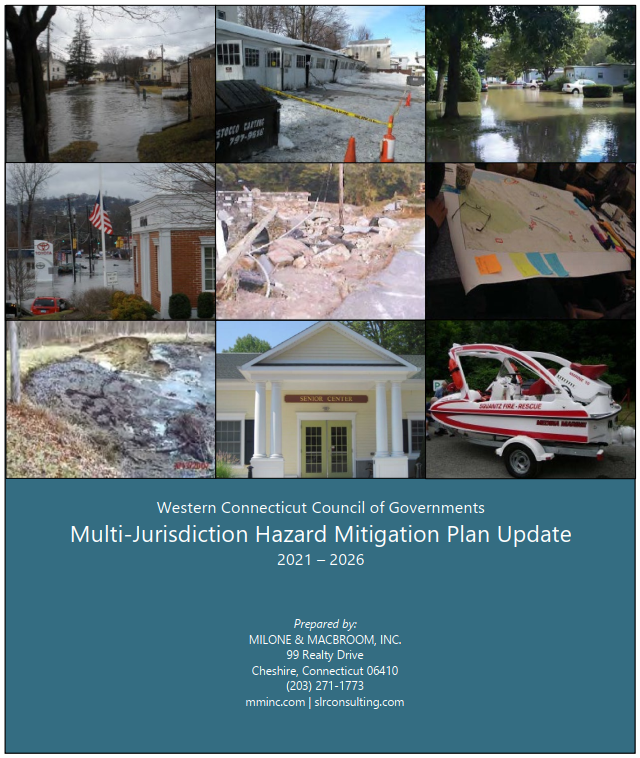
WestCOG Multi-Jurisdiction Hazard Mitigation Plan Update, 2021–2026
Adopted August 16, 2021, with FEMA approval on November 9, 2021.
Introduction
The WestCOG Multi-Jurisdiction Hazard Mitigation Plan Update identifies natural hazards affecting Western Connecticut and provides strategies to reduce risks to people, property, infrastructure, and communities. The plan brings all 18 WestCOG municipalities together under a single regional framework while addressing the unique risks and priorities of each community.
About the Project
Hazard mitigation focuses on actions that can reduce or eliminate the long-term risks associated with natural hazards and disasters. WestCOG developed this plan to provide a coordinated approach to identifying hazards, assessing community vulnerabilities, and advancing strategies that can improve regional and local resilience.
This was the first multi-jurisdiction hazard mitigation plan to concurrently cover all 18 municipalities in the WestCOG region. The plan uses a Regional Plan–Municipal Annex format, allowing regional information and shared challenges to be addressed in one document while providing detailed information and mitigation actions for each member municipality.
The plan evaluates hazards affecting the region, including:
- Flooding
- Hurricanes and tropical storms
- Severe thunderstorms and high winds
- Tornadoes
- Severe winter storms
- Drought
- Earthquakes
- Wildfires
- Dam failure
The plan also addresses the potential risk associated with terrorism and mass casualty events.
WestCOG’s overarching goal is to reduce loss of life, damage to property and infrastructure, and costs to residents, businesses, and municipal governments. The plan also emphasizes public education, coordination with other planning efforts, and the protection of natural resource systems.
Understanding Regional and Local Risk
The plan updates information on the extent and impacts of hazards across the region and assesses vulnerabilities, critical facilities, historic and cultural resources, and potential losses. Each municipality also reviewed its existing capabilities, previous mitigation actions, and areas of continuing concern.
Advancing Local Mitigation Actions
Each of the 18 municipalities developed or updated strategies and actions for implementation over the five-year planning period. The plan prioritizes these actions and provides an implementation framework that identifies responsible parties, anticipated timeframes, and potential funding sources.
Supporting Regional Coordination
WestCOG identified several actions intended to support municipalities and address shared regional challenges, including:
- Providing information and guidance on hazard mitigation funding and grant opportunities
- Hosting annual meetings to support plan maintenance and encourage coordination among municipalities
- Helping secure funding for projects that benefit multiple communities
- Assisting communities with hazard mitigation planning and implementation
- Supporting the integration of historic and cultural resource considerations into resilience planning
Addressing Shared Regional Priorities
The plan identifies common themes across WestCOG communities, including emergency response capabilities, energy resilience and backup power, floodplain management, and repetitive-loss properties. Several municipalities also identified common actions related to climate-informed infrastructure design and improving electric grid resilience.
Project Process and Collaboration
The plan was developed through a collaborative process involving WestCOG, municipal coordinators, municipal staff, and members of the public.
Each municipality designated a Local Coordinator to help guide the planning process and ensure that local needs and priorities were represented. Municipal staff contributed information about community capabilities, critical facilities, hazard risks, previous mitigation efforts, and potential future actions.
Because the planning process took place during 2020, public and municipal engagement activities were conducted virtually. The process included:
- Local planning discussions with all 18 municipalities
- Two regional workshops
- An online public survey
- Eight virtual public information meetings
- Outreach to neighboring communities
- Public review and comment on the draft plan
Fifteen municipalities participated in virtual local planning discussions, while three provided feedback through internal discussions and written comments.
WestCOG held eight virtual public meetings to provide residents with information about the plan, answer questions, and gather input. Public comments helped identify hazards of concern, gaps in existing capabilities, and potential mitigation needs.
To expand access to the planning process, WestCOG also developed an online presentation with subtitles in English, Spanish, Portuguese, French, and Polish.
The draft plan and municipal annexes were subsequently made available for municipal and public review before the plan was finalized and adopted.
Project Resources
Final Products
- WestCOG Hazard Mitigation Plan Update, 2021–2026
- Municipal Annexes for each of WestCOG’s 18 member municipalities
- Adoption Resolutions
Supporting Materials
- Appendix D: HAZUS-MH Output
- Appendix E: Sustainable CT Climate Vulnerability Assessment
- Appendix G: FEMA Mitigation Strategy Worksheets
Project and Engagement Materials
- Appendix A: Municipal Planning Process
- Appendix B: Regional Workshops
- Appendix C: Public Outreach
The plan also includes fact sheets addressing regional challenges, climate-related risks, new initiatives, and mitigation success stories.